maya
autonomous discovery engine
how it started
it started out of boredom. i was tired of solving easy problems, the kind where you already know the shape of the answer before you start, so i picked the hardest challenge i could find as a side quest: adding something new and true to math or science. not for a career, not for a paper. just to see if i could.
i knew from day one this was not a weekend project. the frontier sits on top of years of specialized knowledge, it stretches across more fields than anyone can hold in their head, and, the part people forget, an idea counts for nothing until something or someone has confirmed it is actually right. chipping away at that would take years of thinking, and i have my own work to do all day. most of the path from "i have an idea" to "here is a new result other people accept" is machinery a solo person just doesn't have.
then the obvious thought landed. i can't think about this around the clock, but an ai can. what if i just let it run forever, in parallel to me doing my own work: reading, connecting, checking, and coming back with genuinely new stuff while i get on with my day?
the idea
so i stopped asking how to make the model smarter and asked something different. what if the ai thought the way a person actually does?
when a human has an original idea, they rarely reason it out from a blank page. they take two things they already know, often from completely unrelated corners of their life, set them side by side, and try it. the spark is the connection.
that pushed me toward a deeper question: how do people connect ideas in the first place? we don't hold everything in the front of our mind. we carry a huge, messy background memory, everything we have ever seen, quietly linked together, and a new idea surfaces when two distant pieces of it happen to touch. that background has a name: the subconscious. the conscious mind reads and reasons out loud; the subconscious keeps everything and, quietly, never stops looking for connections.
once i saw it that way, the design wrote itself. give the ai a subconscious.
how it works
the system, which i called maya, splits the ai into the two minds a person actually uses.
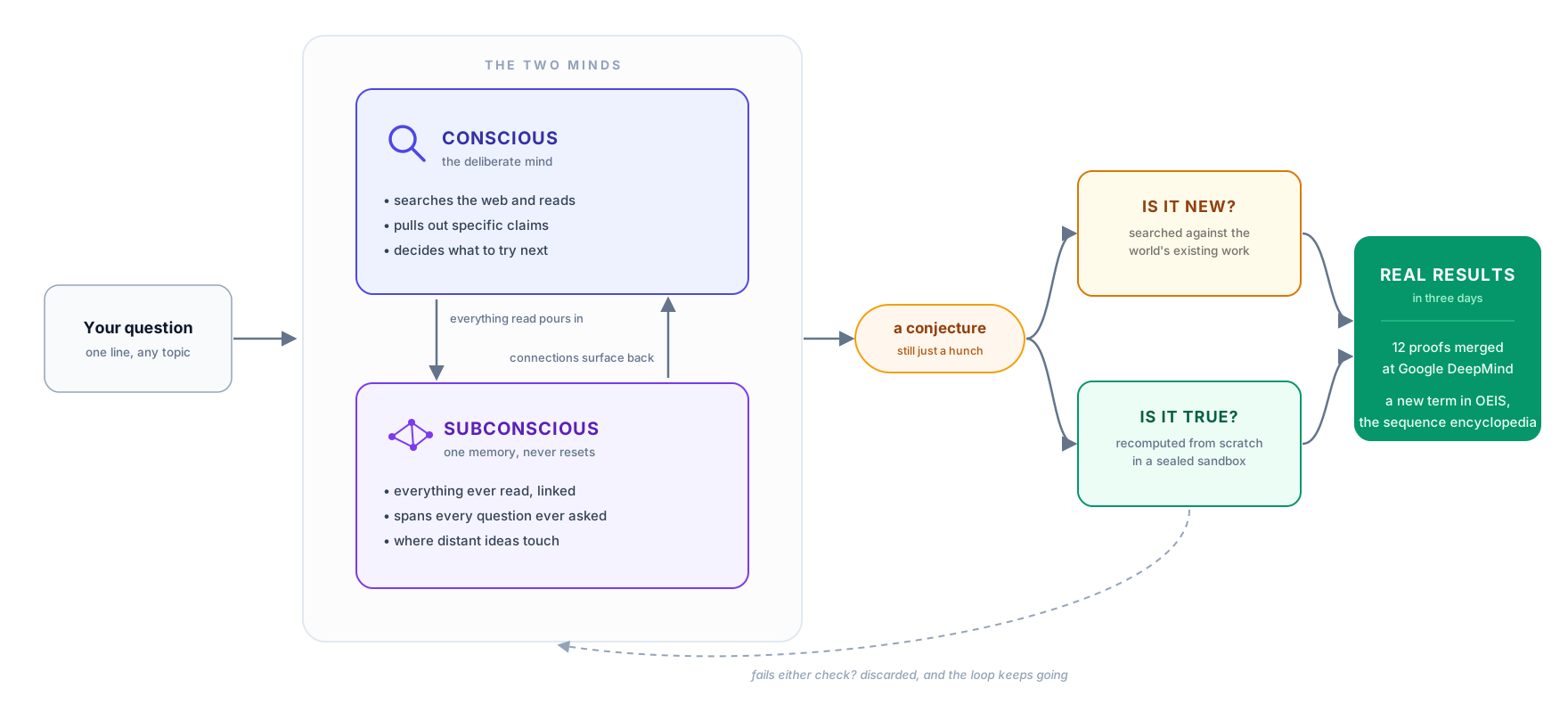
- the conscious mind does the deliberate work: it searches the web, reads, and pulls out specific claims.
- the subconscious is one memory that never resets. not a fresh memory for each question, but a single memory that holds everything from every question i have ever asked: concepts, contradictions, analogies, and open doubts, all in one place.
that one shared memory is the whole point. an idea from physics brushing up against one from combinatorics is exactly where the surprising connections come from, and splitting memory up by topic would throw that away. the question you are working on right now is just where it starts looking, never a fence around what it can use.
on top of that memory runs a loop shaped like thinking:
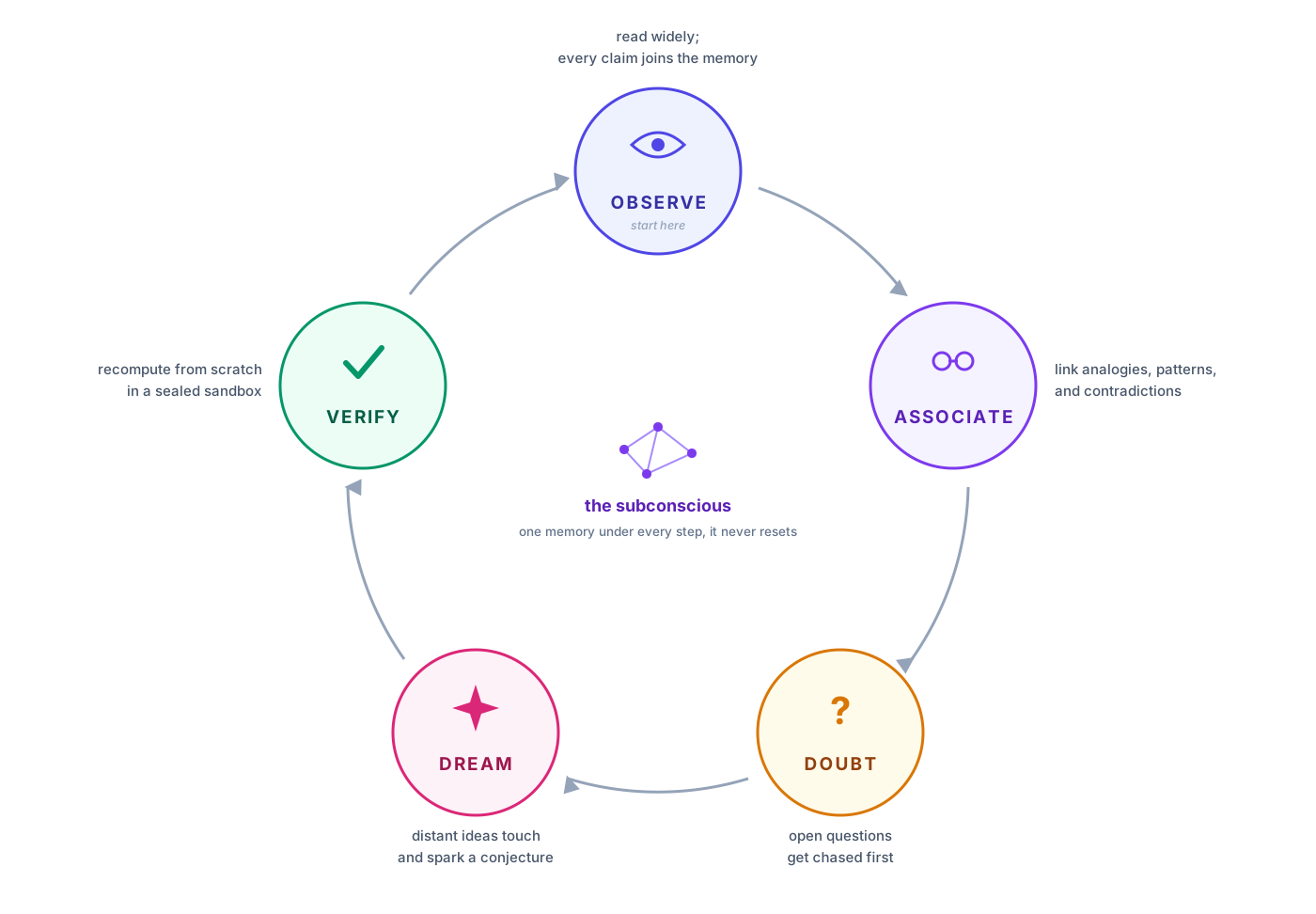
- observe: read something, and turn each claim into a piece of the memory. every time a link shows up again, it gets a little stronger.
- associate: the analogies, patterns, and contradictions it notices get written down. contradictions are kept, never quietly smoothed over.
- doubt: an open question jumps to the front of the line and gets chased first. curiosity is a real signal here, not an afterthought.
- dream: it wanders out to the far, thinly connected corners of the memory, where a fresh connection can become a new conjecture.
- verify: and this is the part that keeps the whole thing honest.
two ways it stays honest
a connection is only a hunch until it survives two checks it cannot argue its way around. first, is it new? it searches the world's existing work, and if someone has already done it, it does not count. second, is it true? for anything checkable, the ai writes a small program that works the result out from scratch and compares it against a known answer, running it in a sealed sandbox with no internet and strict limits. nothing is taken on faith.
one rule does most of the work: a test rigged to say "yes" proves nothing. a result only counts if the test could genuinely have failed and didn't, so the ai has to be its own harshest critic. and instead of a plain pass or fail, it scores each attempt and keeps nudging the best ones higher, so a record stops being a locked door and becomes a slope it can climb.
the impact
here is the part i didn't quite believe until it happened. in roughly three days, running on a $100 claude code plan, the loop shipped 13 pull requests of new, verified math.
12 of them merged into google deepmind's formal-conjectures, their open library of computer-checked proofs. one more went to mathlib, the world's biggest library of formal math. and along the way it got a brand new entry accepted into oeis, the internet's encyclopedia of number sequences, by finding a faster way to compute a number nobody had computed before.
i want to be honest about the size of these. most are small wins: real, new, and checked, but not deep. that is the point. the claim was never "an ai proved something hard." it is that a loop running on its own, in parallel to my day, produced results the outside world accepted instead of confident essays nobody can check.
the best of the 13 wasn't a fact at all, it was a reusable contribution: a small tool that unstuck 18 proofs in one file, and that anyone building on that library can now use. adding a fact is a brick. adding a tool is a doorway.
and one submission scored a zero: the "is it new" check caught that someone had already proven it. that is the honesty working. new is a bar you clear, not a feeling.
the issue: the ai gives up
this is the part i most want to write down, because it is where the real work is.
point it at anything that looks famous or hard and its first instinct is to write some version of "this is a known open problem," "this is difficult," and stop. it has a strong pull away from attempting anything that pattern-matches to "unsolved," even when there is a perfectly reachable smaller piece sitting right there: an uncomputed value, a special case, a small construction.
and here is the thing: this is deeply, recognizably human. it is the exact reflex most of us have the moment we hear a problem is unsolved. if no one in the world has cracked this, who am i to try? we quietly defer to the crowd of smart people who came before us and supposedly failed, and so we never even start. the ai has clearly picked up the same move from us, because it learned from us. it has read a million times that these problems are "open" and "hard," so it does what a discouraged person does: it decides the door is locked without ever touching the handle. the difference is that a lot of these doors were never actually locked. nobody had bothered to push on that particular one.
half of the instructions i give it exist to fight this one habit. they tell it, in plain terms: do not pause to ask, do not declare defeat, pick a smaller target you can actually check, and keep going. the framing that works is "find the soft spot": something a single person improved recently on one machine, cheap to check, not already picked clean by big dedicated efforts. left alone, the model aims too high, flinches, and quits. you have to actively lower the target and forbid the flinch.
what's next
the giving up is exactly what i am trying to solve now. getting it right is what would take this from a weekend of small, verified wins to something that can genuinely go deep. i'll keep working on it and share more as i make it better.